
LLM x DATA
A Comprehensive Review of the Symbiotic Relationship Between Large Language Models and Data Management

Table of Contents
Overview
The relationship between Large Language Models (LLMs) and data management has evolved into a critical area of research, with both fields experiencing rapid transformation through their mutual influence. This comprehensive survey examines the bidirectional synergy between LLMs and data management systems, providing a systematic framework for understanding how data management supports LLM development and deployment, while also exploring how LLMs can enhance traditional data management tasks.
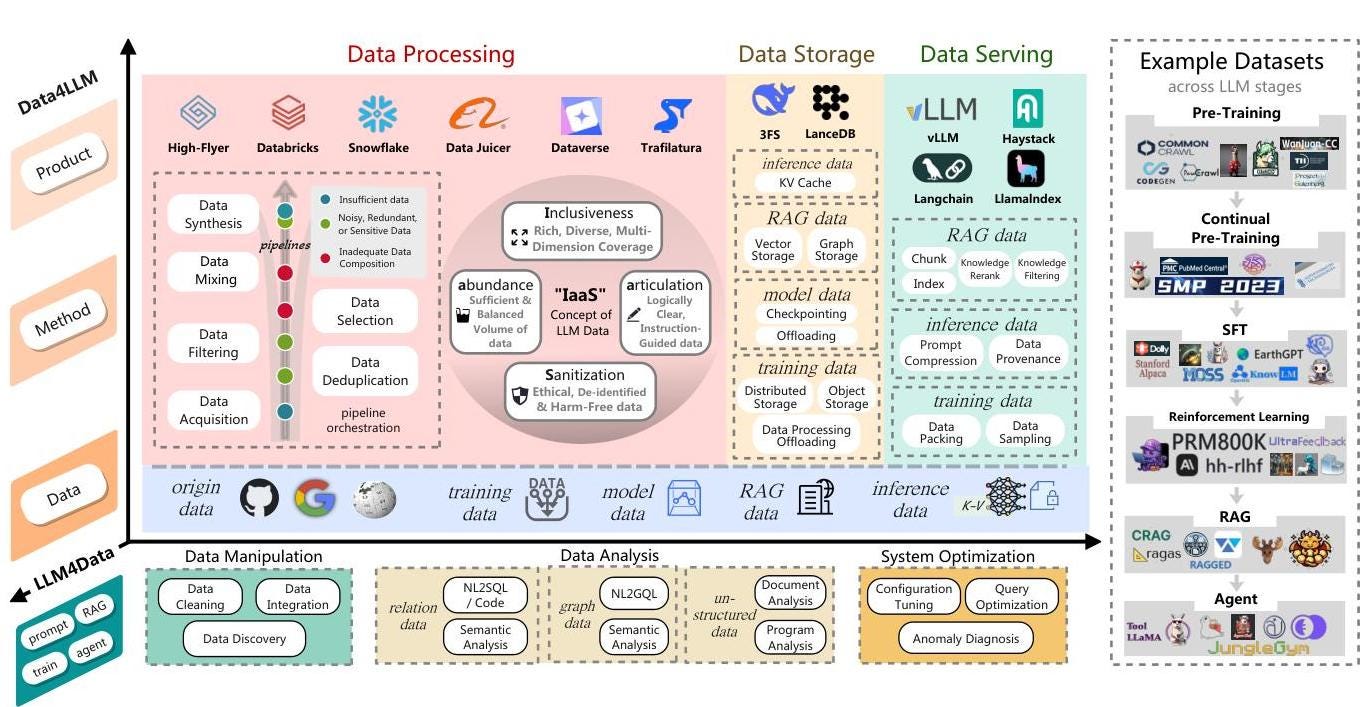
The survey addresses a significant gap in existing literature by offering a holistic view of this interdisciplinary field. Unlike previous surveys that focused on specific aspects such as data selection or deduplication, this work provides a comprehensive lifecycle-oriented perspective that spans from LLM pre-training to deployment in agent-based applications.
The IaaS Framework for LLM Data Quality
A key contribution of this survey is the introduction of the "IaaS" concept, which provides a principled framework for evaluating LLM dataset quality across four dimensions:
Inclusiveness: Ensuring diverse coverage across domains, tasks, sources, languages, styles, and modalities
Abundance: Maintaining sufficient volume and balanced composition to prevent overfitting
Articulation: Providing well-formatted, clean, self-contained, and instructive data with step-by-step reasoning
Sanitization: Implementing rigorous filtering to remove harmful content including private information, toxic language, biased content, and unverified information
This framework moves beyond ad-hoc quality metrics to offer a systematic approach for evaluating and improving datasets throughout the LLM lifecycle.
Data Management for LLMs (DATA4LLM)
The survey systematically categorizes data requirements and management techniques across different LLM stages, revealing how data characteristics vary significantly throughout the model lifecycle.
Data Characteristics Across LLM Stages
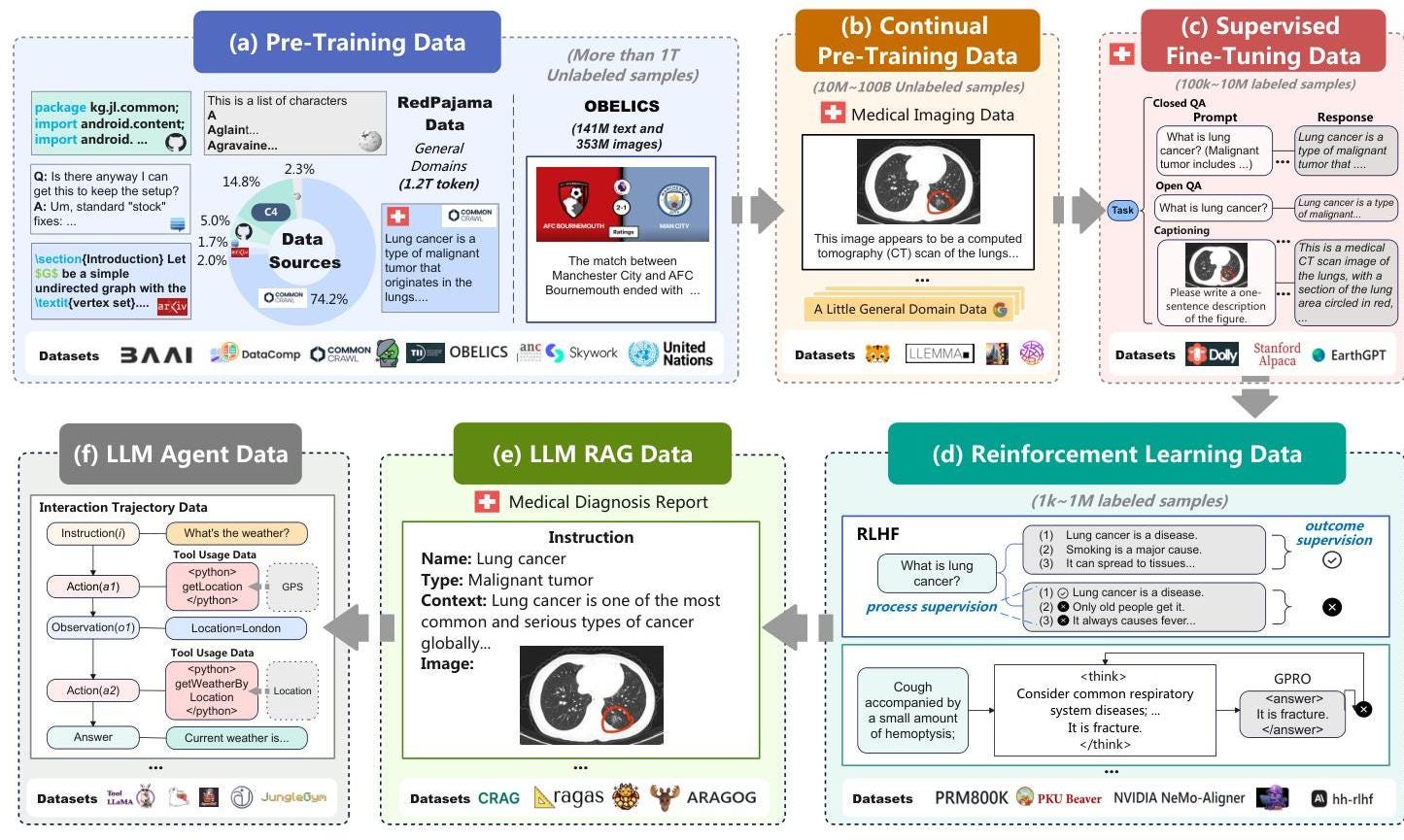
Each stage of LLM development presents unique data requirements:
Pre-training: Requires terabyte-scale, diverse, multi-modal data for broad understanding
Continual Pre-training: Uses millions to billions of tokens of domain-specific data to fill knowledge gaps
Supervised Fine-Tuning (SFT): Employs thousands to millions of instruction-response pairs for task alignment
Reinforcement Learning: Utilizes smaller datasets with human preference feedback (RLHF) or correctness feedback
Retrieval-Augmented Generation (RAG): Requires large-scale, authentic, and dynamic reference corpora
LLM Evaluation: Needs representative benchmark datasets for capability assessment
LLM Agents: Uses interaction trajectory and tool usage data for planning and orchestration
Data Processing Techniques
The survey details sophisticated data processing pipelines that have evolved specifically for LLM requirements:
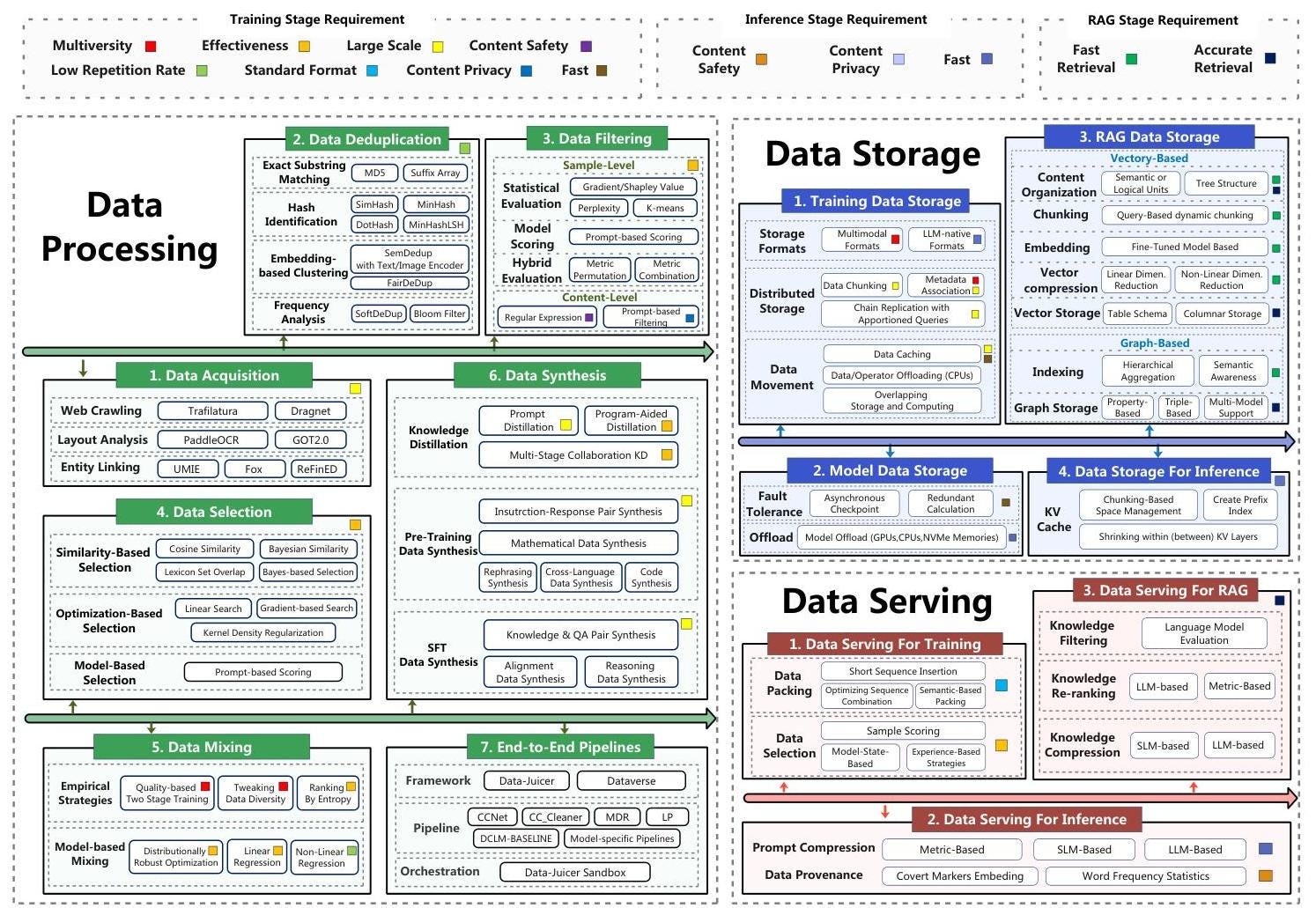
Data Acquisition has advanced beyond simple web scraping to include complex crawling strategies, sophisticated layout analysis using OCR pipelines and multimodal LLMs, and entity recognition for structured information extraction.
Deduplication techniques range from exact substring matching using MD5 hashes and suffix arrays to approximate methods using SimHash and MinHashLSH, and advanced embedding-based clustering for semantic redundancy removal.
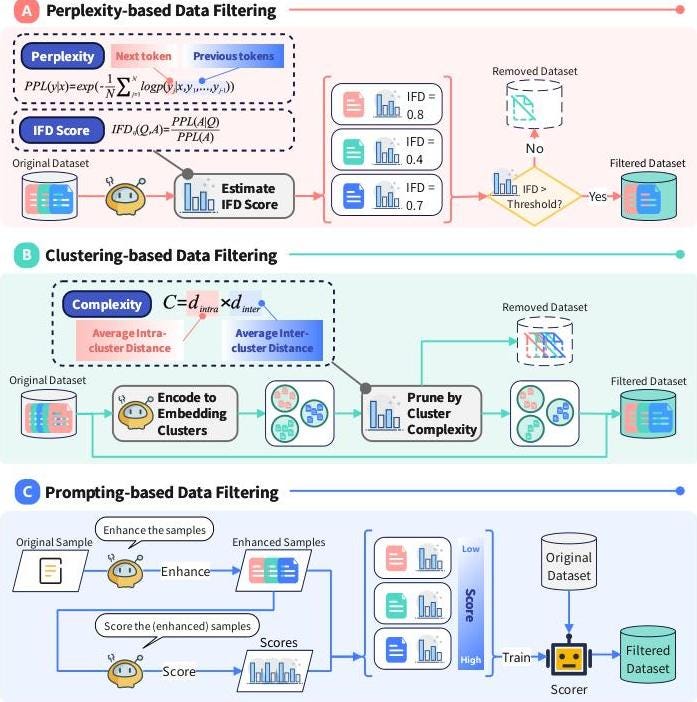
Data Filtering operates at both sample and content levels. Sample-level filtering uses perplexity scores, influence assessment, clustering, and LLM-based scoring. Content-level filtering focuses on removing personally identifiable information, toxic content, and biased material.
Data Selection employs similarity-based approaches using cosine similarity and bag-of-words, optimization-based methods using gradient influence, and model-based approaches where LLMs score data quality.
Data Mixing strategies combine diverse datasets through heuristic adjustments, model-based optimization using scaling laws, and advanced techniques like bilevel optimization during training.
Data Storage and Serving
The survey addresses the unique storage and serving challenges posed by massive LLM assets. Specialized formats like Safetensors ensure secure model storage, while distributed file systems handle massive training datasets. For RAG applications, data is organized into vector-based structures (chunking, embedding, compression) and graph-based structures for optimized retrieval.
Data serving techniques include sophisticated shuffling strategies for training efficiency, compression methods for managing context window limits, and provenance tracking to ensure factual consistency in LLM outputs.
LLMs for Data Management (LLM4DATA)
The survey demonstrates how LLMs are transforming traditional data management by acting as general-purpose engines for various data tasks.
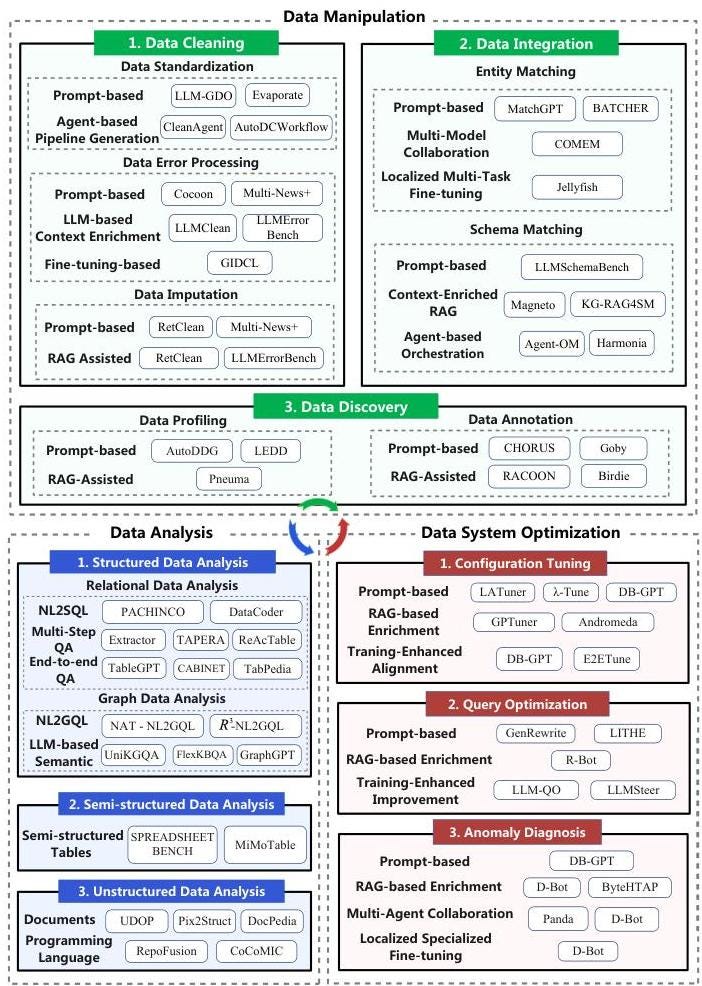
Data Manipulation
LLMs have shown remarkable capabilities in automating data quality tasks:
Data Cleaning: LLMs perform standardization through prompt-based approaches and agent-generated pipelines, handle error processing through context enrichment and fine-tuning, and conduct data imputation using structured prompts and RAG assistance.
Data Integration: Entity matching benefits from LLMs' semantic understanding through structured prompts and multi-model collaboration. Schema matching leverages LLMs' ability to understand semantic relationships between different data schemas.
Data Discovery: LLMs facilitate automated data profiling by generating natural language descriptions and enable intelligent data annotation through semantic label assignment.
Data Analysis
LLMs provide advanced analytical capabilities across different data types:
Structured Data Analysis includes natural language to SQL (NL2SQL) and natural language to code (NL2Code) translations, enabling non-technical users to query databases. For complex queries, multi-step question answering decomposes problems iteratively, while end-to-end approaches use table-specific fine-tuning.
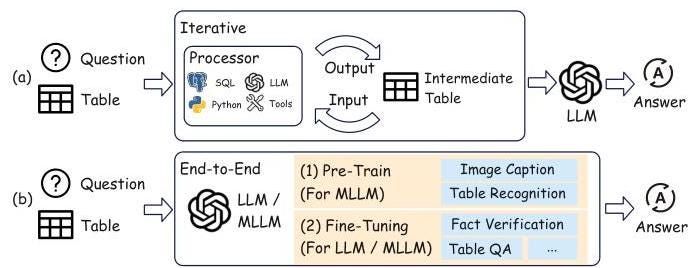
Graph Data Analysis benefits from NL2GQL capabilities that simplify graph query generation, while semantic analysis employs retrieval-then-reasoning and execution-then-reasoning strategies.
Unstructured Data Analysis leverages both OCR-dependent methods that integrate textual, layout, and visual features, and OCR-free approaches using end-to-end multimodal LLMs. For programming languages, LLMs serve as vulnerability detection tools and enable semantic-aware tasks like code summarization.
System Optimization
LLMs are increasingly applied to core database system tasks:
Configuration Tuning: LLMs assist in identifying optimal database parameters through task-aware prompt engineering and RAG-based historical experience integration.
Query Optimization: LLMs help rewrite queries and select optimal execution plans using optimization-aware prompts and fine-tuning approaches.
Anomaly Diagnosis: LLMs analyze system anomalies and suggest solutions through multi-agent collaboration and localized fine-tuning, aiming to emulate human database administrator expertise.
Technical Innovations and Methodologies
The survey highlights several technical innovations that have emerged from the LLM-data management intersection:
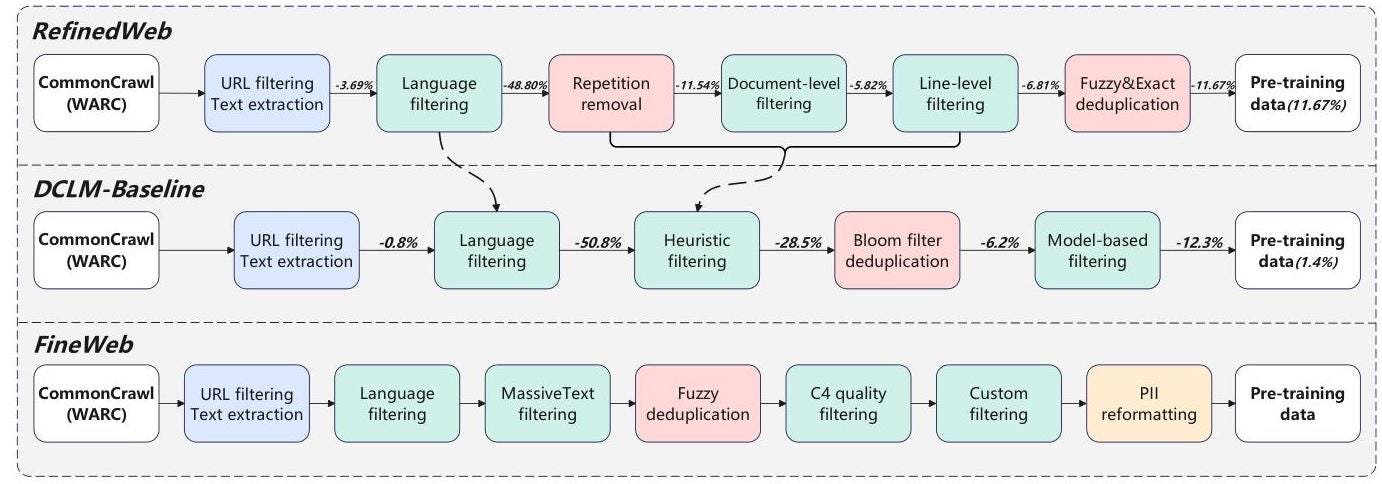
End-to-End Data Pipelines: Modern systems like DCLM-Baseline and FineWeb integrate multiple processing stages into comprehensive pipelines, though their design remains largely empirical and resource-intensive.
Distributed Storage Systems: Specialized systems like JuiceFS and 3FS handle massive training datasets, while heterogeneous storage approaches like ZeRO and ProTrain manage model parameters across diverse hardware configurations.
Advanced Filtering Techniques: The survey details sophisticated filtering approaches including perplexity-based filtering, clustering-based methods, and prompting-based techniques that leverage LLMs themselves for data quality assessment.
Open Challenges and Future Directions
The survey identifies several critical research gaps and practical challenges:
For DATA4LLM: Key challenges include developing task-specific data selection methods for efficient pre-training, optimizing complex data processing pipelines, managing LLM knowledge updates and version control, creating comprehensive dataset evaluation methods that don't require full model training, and developing unified indexing approaches for RAG systems.
For LLM4DATA: Important challenges include creating unified analysis systems that handle diverse data types, integrating private domain knowledge effectively, developing expressive representations for non-sequential data, and optimizing LLM utilization under budget constraints.
Significance and Impact
This survey represents a foundational contribution to the rapidly evolving field of LLM-data management integration. By providing a systematic framework for understanding the bidirectional relationship between LLMs and data management, it offers both researchers and practitioners a comprehensive roadmap for navigating this complex interdisciplinary area.
The work's significance extends beyond academic research to practical applications in industry, where the efficient management of data for LLMs and the application of LLMs to data management tasks are becoming increasingly critical for competitive advantage. The survey's comprehensive coverage of over 400 papers and its structured approach to categorizing techniques and identifying research gaps positions it as an essential resource for future development in this field.
The introduction of the IaaS framework provides a much-needed principled approach to data quality evaluation, while the detailed technical categorizations offer practical guidance for implementing LLM-data integration solutions. As the field continues to evolve rapidly, this survey serves as both a comprehensive reference and a foundation for future research directions.